
Moscow Previous Residents by Era
No single Moscow source covers every year or every occupant. Start with the period under study, then choose the record whose original purpose fits the question. Deeds follow legal interests in land. Directories follow subscribers or surveyed entries. Census schedules follow households at a public-release interval, and maps follow buildings rather than people.
| Source | Years It Covers | Where Held | What It Shows |
|---|---|---|---|
| Latah recorder index | Online start year not published | Auditor portal; older books or microfilm in office | Grantor, grantee, document, book/page, legal description |
| Moscow telephone directories | 1920–21; 1922–27/28; 1930–70; 1972–84/85 onward | UI Special Collections | Dated subscribers, addresses, and phone numbers |
| Ott directory image | 1910 | UI Digital Collections | A dated Moscow directory page and metadata |
| Federal census | Territorial schedules through 1930 listed by UI; later releases follow the 72-year rule | UI, NARA, and archival databases | Household names, ages, relationships, and geography |
| Moscow Sanborn map | 1909; wider Idaho collection 1884–1929 | UI Digital Sanborn | Structure, lot, use, and street context, not ownership |
| Latah newspapers | 1889 to current in scattered, overlapping runs | UI, state historical society, and LCHS | Sales, obituaries, moves, court, and social notices |
For a recent address, start with the assessor and deed chain. For the twentieth century, move from a deed date into the closest directory and newspaper issue. For an early Moscow building, start with the legal description, historic plat, Sanborn sheet, and census geography. Each step should preserve the record date.
Start Moscow Resident Address History
Latah Public Access gives the present-day anchor. Capture the parcel identifier, owner field, physical or situs address, mailing address, legal description, value, exemption clues, and any GIS or plat link. A mailing address is only the destination for a notice; it does not establish where the owner lives.
The legal description is the most useful bridge into old records. A lot, block, subdivision, or tract can remain stable when a Moscow street number changes or a rural parcel is later assigned a city address.
Trace Moscow Resident Ownership Backward
A chain of title is the linked series of recorded transfers affecting one parcel. The Latah County recorded-document search works by name or instrument number, not by street address alone. Keep the parcel's legal description beside every result so a common name or multi-parcel owner does not lead away from the house.
- Copy the current owner, parcel ID, and full legal description from the assessor record.
- Search the owner's name in “Lastname, Firstname” order and identify the acquisition deed. Confirm party role, document type, book and page, and legal description.
- Take the seller's name from that transfer. Search that person as both grantor and grantee to locate the prior acquisition affecting the same land.
- Repeat the process. Treat mortgages, reconveyances, easements, and trustee documents as context unless the recorded instrument confirms a transfer.
- When the web index ends or an image is unavailable, request the exact instrument, book/page, or older index-room search from the Auditor.
- Grantor / grantee
- The grantor gives an interest; the grantee receives it. Confirm the role on the recorded document.
- Chain of title
- The sequence of deeds and other transfers tied to the same parcel.
- Legal description
- The lot, block, subdivision, tract, or boundary wording that identifies land apart from its postal address.
Moscow Previous Residents Beyond the Portal
The recorder search can return document, book and page, party name, party type, document type, and total pages. It caps results at 5,000 and does not display documents longer than 50 pages online. Most important, the county did not publish the online index start year in the inspected source.
Do not call a no-result a complete search. Contact the Latah Auditor at 522 S Adams, Room 101, Moscow, or (208) 883-2249. Ask for courthouse books, microfilm, or an index-room search, and scope the request with the exact name, legal description, date range, and document type. Paper copies are listed at $1 per page, with $1 per document for certification; verify the schedule before paying.
Insider tip. The published start year is unknown, so the clerk fallback is part of the method, not a last resort after guessing.
Moscow Resident Records Meet Sanborn
Sanborn fire-insurance maps add the structure to a Moscow previous residents search. They can show a footprint, lot setting, number of stories, use, outbuildings, and nearby street context. They cannot prove who owned or occupied the building.
View the University of Idaho's Moscow 1909 Sanborn item before comparing it with a modern parcel and deed.
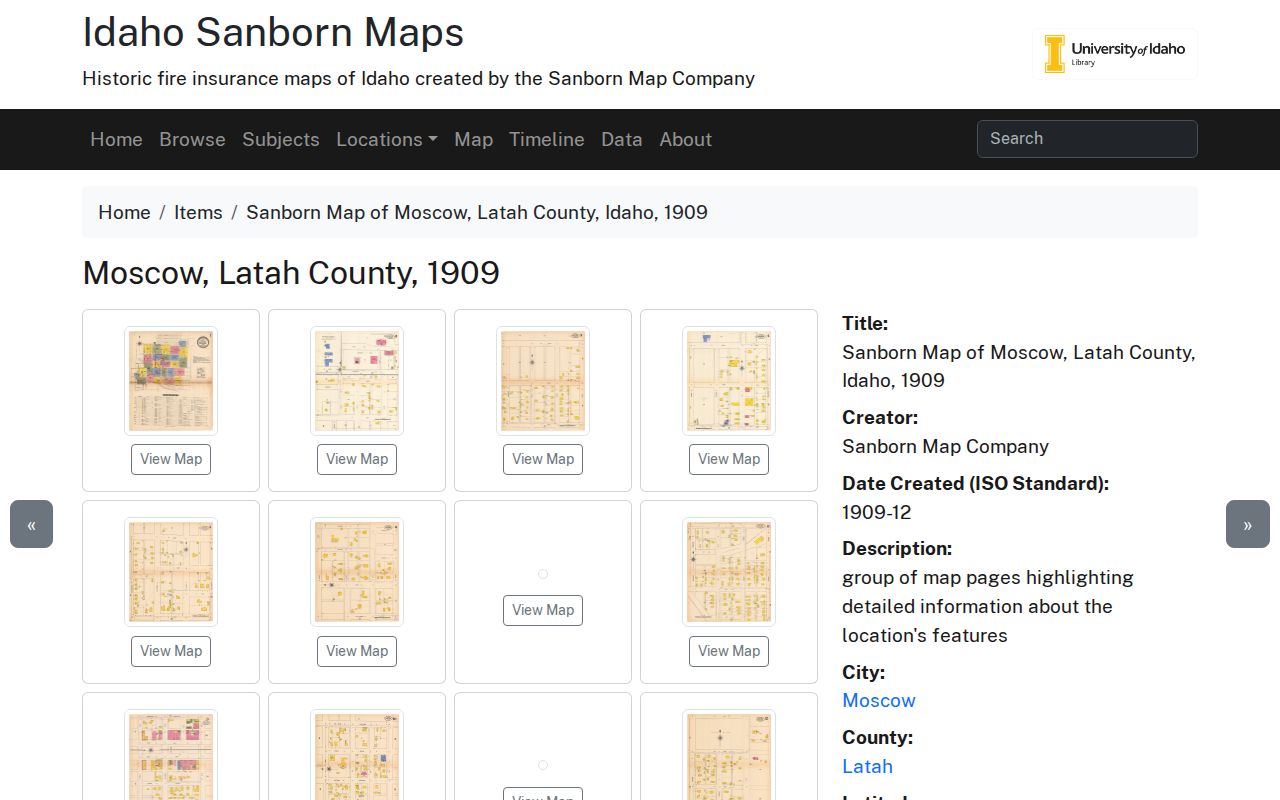
The map image dates the built environment. Pair its lot and street details with a legal description and directory entry before attaching a person to the site.
Moscow Resident Addresses That Shift
Moscow's current address map contains named and lettered streets, directionals, campus roads, private lanes, extensions, and grid references. Early records may instead use Main Street, a rural route, a tract, or a short street form. No verified citywide renumbering year was found, so assigning one would create a false break in the trail.
Test a suspected change with the historic plat, deed legal description, 1909 Sanborn map, directory abbreviation, and fixed nearby landmarks. For a boundary issue, City ordinance and annexation records can show when a parcel entered municipal limits. A Moscow postal label by itself does not settle that question.
Moscow Resident Research at LCHS
The Latah County Historical Society expressly helps people determine who once lived in a home. Its collections include photographs, oral histories, papers, maps, local books, newspaper material, cemetery inscriptions, probate records, and transcribed local vital notices. Most are not online.
Research takes place at the Centennial Annex, 327 E 2nd Street in Moscow. The stated hours are Tuesday through Friday, 9:00 a.m. to 4:00 p.m., with appointments requested at least 48 hours ahead. Remote mail, phone, and email requests are available. Give staff the address, rough period, known names, parcel ID, and legal description.
Note: LCHS does not hold certified birth, death, or marriage certificates; those requests belong with the county or Idaho vital-records office.
Link Moscow Resident Directories to Census
Owners are only one part of a property's story. Telephone books can identify a subscriber, city directories may add a spouse, occupation, address, or reverse section, and a census can identify a household within its released schedule. None should be treated as a complete resident roll.
- Choose the directory issue closest to a deed, permit, or known event and copy the entry exactly.
- Search at least one issue before and after it. Record initials, spouse notation, street abbreviation, and phone number as printed.
- Move to the nearest public census year and confirm the household, age, relationships, and enumeration geography.
- Use newspapers, probate, cemetery, or a successor deed to explain a move, death, inheritance, or name change.
The University of Idaho lists Moscow telephone runs for 1920–21, 1922–27/28, 1930–70, and 1972–84/85 onward. Its holdings are substantial but incomplete. Details about reading the volumes belong with the Moscow city directory collections.
Close Moscow Previous Resident Trails
Moscow newspaper holdings overlap rather than forming one perfect run. University of Idaho and state lists include the Moscow Mirror, Evening Journal, Weekly and Daily Star-Mirror, Idaho Post, Daily Idahonian, Idahonian, News-Review titles, and Moscow-Pullman Daily News. Search the exact publication and issue span instead of assuming one database covers all years.
An obituary or probate file can name relatives, an executor, a former address, or the next jurisdiction. Cemetery records can supply a burial lead. FamilySearch catalogs Latah court material from 1889–1939, county birth and death material with variable 1883–1929 coverage, and county marriage images in a broader 1864–1962 collection. Index access and image access may differ.
Judge Moscow Previous Resident Evidence
A strong conclusion states what each record actually proves. A deed names legal parties. A directory names a subscriber or surveyed entry. A census lists a household for its enumeration date. A newspaper tells a dated story, while a Sanborn map describes the structure. Agreement among independent sources is more persuasive than repeated copies of one index.
Also record the negative evidence. A person may be absent because a directory issue is missing, the home lacked telephone service, a married name was used, the address changed, or a census boundary differs from today's Moscow city limits. Absence is not proof that the person never lived there.
Lawful use. Research Moscow previous residents for house history, genealogy, estate work, or personal curiosity. Never use a historical trail to track, harass, or harm a living person.