
Sources Around Moscow Neighbors
A Moscow block is best treated as a set of parcels, not a household roster. Latah County's map establishes lot shapes and adjacency. Public Access adds the recorded owner, mailing address, situs address, value, and exemption context available for each parcel. The recorder can connect that parcel with named parties on deeds and other filed documents. City maps and permit records explain street and building context. Each source has a separate job, and none proves every person who occupies a property.
| Source | What It Shows About a Block | Access |
|---|---|---|
| Latah GIS Parcel Viewer | Parcel shapes, adjacency, districts, and map context | Free public map; live controls can change |
| Latah Public Access | Owner, mailing and situs fields, value, exemption context | Basic free; registered advanced tools |
| Recorder index | Named document parties and parcel history | Search free; copies paid; online limits |
| Moscow city maps | Street numbers, city limits, roads, zoning, historic context | Web maps and Engineering records |
| Voter and precinct sources | Precinct geography and limited lawful voter fields | Protected fields and use limits apply |
| LCHS and UI collections | Past occupants, buildings, photos, papers, and newspapers | Reading room, appointment, or remote request |
A mailing address is where the assessor sends mail. A situs address identifies the property itself. If the two differ, that does not show where the owner lives. Likewise, a recorded owner may be a trust, business, family estate, or person living elsewhere. Keep owner and occupant claims separate. When the goal expands from the nearby lots to every address on a named road, the Moscow street directory provides the fuller street-level chain.
Map Moscow Neighbors by Parcel
Start with one verified situs address in the Latah GIS Public Map. The inspected text did not expose whether the current viewer has a buffer, radius, or multi-select tool, so do not assume one exists. A consistent manual method works: identify the target shape, then click each parcel that touches it and each parcel directly across the street. Open every parcel separately in Public Access before recording an owner.
- Find the target situs address and save its parcel ID and legal description.
- Zoom to the visible lot lines. Click each contiguous and across-street parcel using the same rule.
- Record each parcel ID and situs, then open its separate assessor card for owner and mailing fields.
- Add the recorder instrument and map date. Keep each parcel on its own block card.
The resulting process is simple: target address → parcel boundary → adjacent parcel IDs → assessor cards → recorder documents. A legal description identifies land by its recorded lot, block, plat, or survey terms. It is more stable than a street label, and it helps prevent two nearby parcels from being merged. Note the map date and any tool limits so another person can repeat the work.
Note: Latah GIS confirms geography, while the assessor and recorder provide the separate owner and document records behind each parcel.
Moscow Maps Define the Block
The City of Moscow Maps page supplies address, city-limit, road, zoning, and other Engineering map routes. Those maps help settle whether a road segment lies inside the city, which street number pattern applies, and what civic layer surrounds it. They complement the county parcel viewer rather than replace it. A Moscow mailing label or ZIP alone does not prove that a parcel sits within municipal limits.
The official city maps shown in the manifest provide a visual entry point for neighbor research.
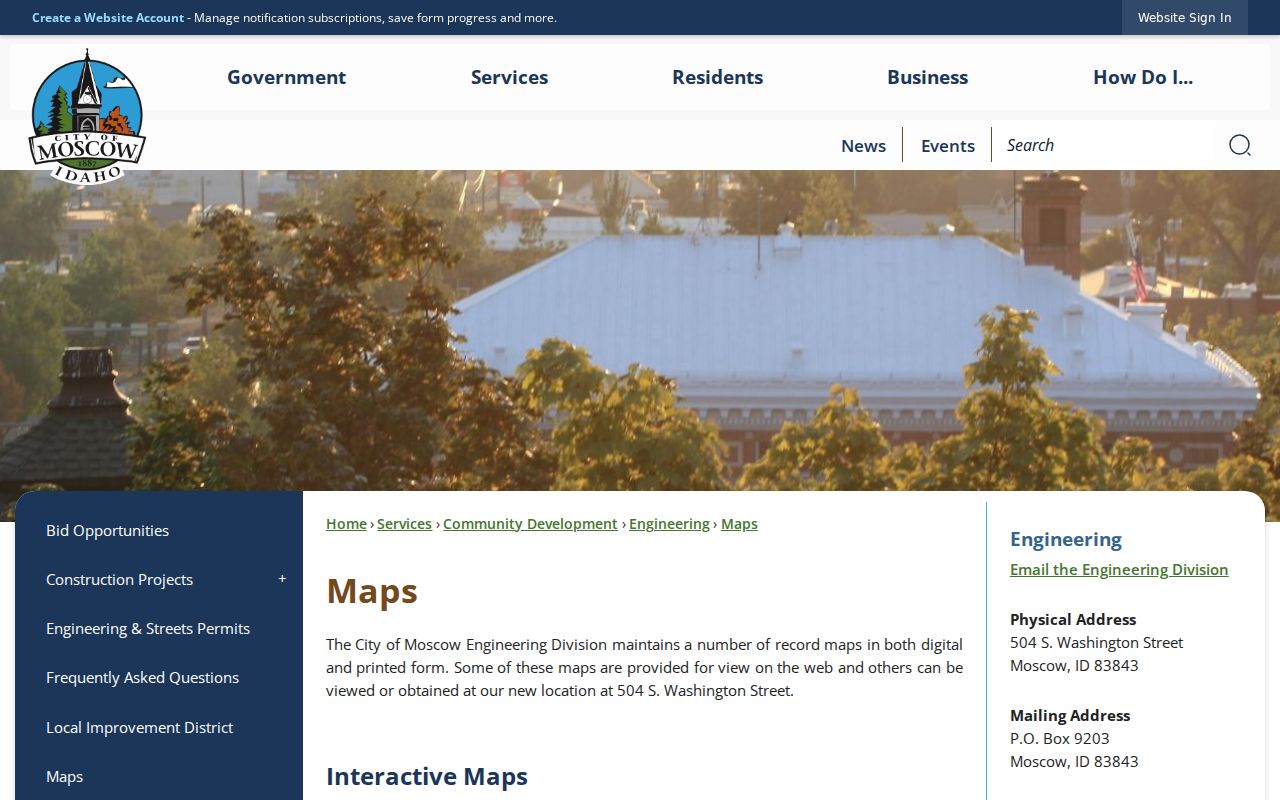
Use the city map to label the block's streets and jurisdiction, then return to Latah County records for parcel-specific ownership facts.
Historic Layers Around Moscow Neighbors
Three named historic areas give Moscow blocks distinct research paths. The Downtown Historic District follows Main Street between Sixth and First streets in city planning material. Fort Russell has a separate district boundary and map. The University of Idaho Historic District adds a campus-centered layer recognized by the State Historical Society. District status can point to nomination files, dated building descriptions, commission minutes, and photographs, not to a current household list.
The Moscow Historic Preservation Commission is a nine-member city commission and meets at 504 S Washington. For deeper block history, the Latah County Historical Society offers photographs, maps, oral histories, local papers, and house-history help, usually by appointment with at least 48 hours' notice. UI Special Collections adds Sanborn maps, newspapers, telephone directories, university materials, and historic images. These sources can show how a block looked before today's parcels and street uses.
Moscow Civic Groups, Not Rosters
No current official city or county directory of Moscow neighborhood associations, HOAs, block-watch groups, or member rosters was located. That gap matters. An unverified social-media list should not be substituted for an official community directory. The City Residents page links civic resources, commissions, elections, parks, history, forms, and the Moscow Sister City Association, but it does not identify households by neighborhood.
| Local organization | Useful block context | What it is not |
|---|---|---|
| Moscow Historic Preservation Commission | District maps, public meetings, preservation files | A resident or owner roster |
| City Residents resources | Civic links, commissions, services, and forms | An association membership list |
| Moscow Chamber, 411 S Main, (208) 882-1800 | Member businesses and downtown organizations | A household directory |
| Latah County Historical Society, 327 E Second | Historic photos, papers, maps, house research | A live block directory |
The Chamber member directory can identify a business at a commercial address. It cannot establish who lives above, behind, or near that business. Contact the city or county custodian when a specific civic record is needed.
Moscow Precincts Are Geography
Latah GIS links precincts and districts viewed by parcel, and Latah Elections links Moscow precinct and commissioner maps. These tools show election geography. They are not voter rosters. Idaho law may open parts of statewide voter database information, but the physical application is exempt or redacted, full birth dates and driver-license numbers stay protected, and Address Confidentiality Program records use a designated address.
The static VoteIdaho inspection did not show a block or radius search. Any lawful voter-file request must use the separate state process and comply with Idaho Code §74-120, which restricts mailing or telephone-list use. Participation history, if released, never reveals a ballot choice. For routing, call Latah Elections at (208) 883-2278 or use the county office at 522 S Adams Street, Suite 101.
Moscow Blocks Through Permit Records
Building permits and code records can add a dated construction layer to a neighbor search. Moscow's permit system and city records may identify an address, project, permit type, status, parcel, owner, applicant, contractor, inspection, or valuation when releasable. Exact live fields and full historical coverage were not established, so use the portal as a lead and request the specific existing record when the result is incomplete.
City administrative records have used NextRequest since May 2026. Moscow Police keeps a separate public-records request route. The successful manifest image below shows that official MPD request page.
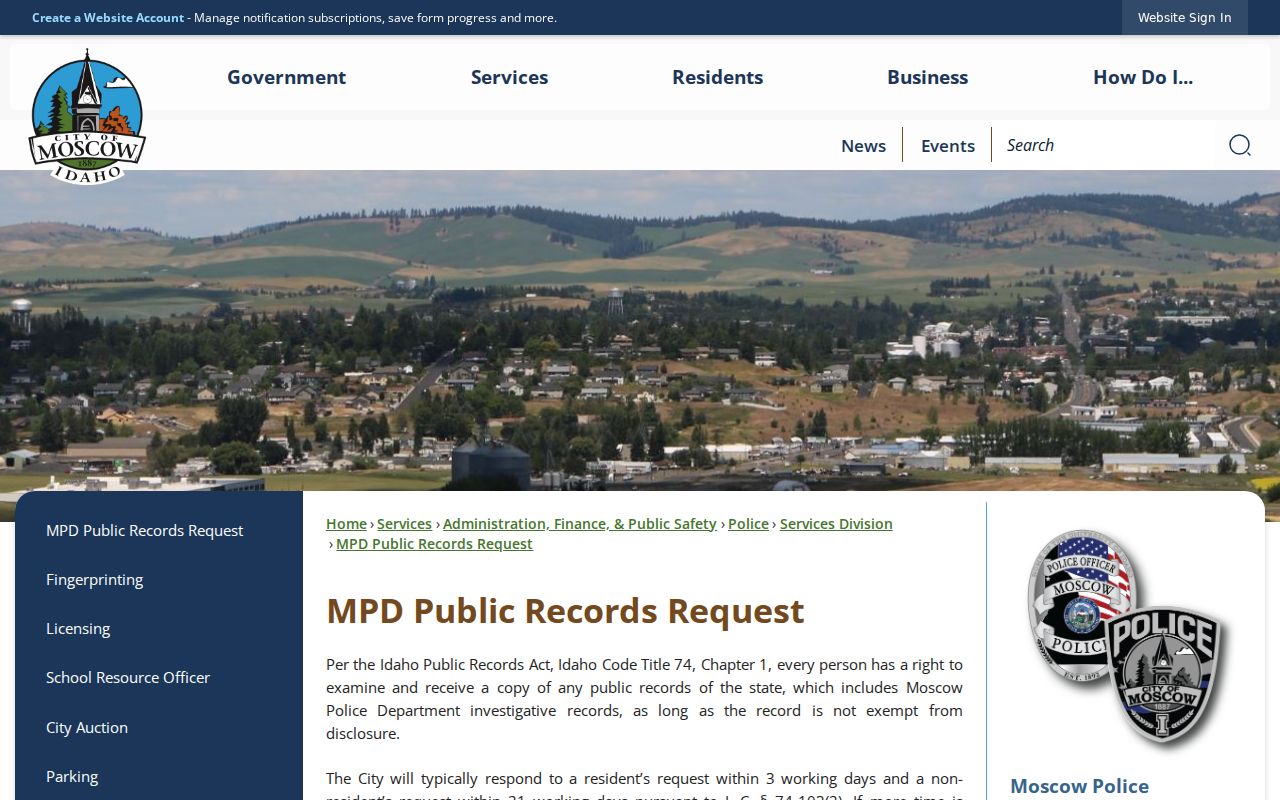
Ask only for a defined incident, address, date range, or document. Restricted police details remain closed, and an address-linked report does not identify all nearby residents.
Official Moscow Neighbor Records
Official rolls and commercial neighbor tools answer different questions. County and city sources identify the custodian, date, parcel, instrument, or map behind a fact. Commercial services may merge public filings with marketing data and inferred associations. The result can be quick, but a stale address or same-name merge is hard to audit. Do not treat an inferred household link as a government record.
| Source type | Strength | Main caution |
|---|---|---|
| GIS and assessor | Dated parcel and owner context | Owner does not always occupy the parcel |
| Recorder and city files | Named filed document or address record | Index may require a copy or written request |
| Historical collections | Past building and occupant clues | Coverage has gaps and must be dated |
| Commercial category | Broad compiled leads | Stale, merged, inferred, and hard to verify |
For an auditable result, keep the trail parcel → assessor → recorder → historic source. Save the record date and note whether each item is an index, image, current portal result, or transcription.
Privacy Around Moscow Neighbors
A parcel owner is not every resident, visitor, family member, or occupant at that address. Utility customers, DMV addresses, protected voter residences, physical voter applications, restricted court and police files, confidential vital certificates, and unlisted subscribers are not open block-directory material. A mailing address is not an invitation to contact someone. Idaho's Address Confidentiality Program can shield qualifying survivors through a substitute address and mail forwarding.
Block research is useful for understanding parcel layout, civic boundaries, building history, public projects, and dated ownership. Keep private fields out of any notes meant for others. If a record seems wrong, contact the office that holds it and cite the parcel, case, instrument, or request number. Do not try to fill a protected gap by merging several weak sources.
Lawful use. Research Moscow neighbors only for lawful personal or civic reasons. Never use block records to watch, stalk, harass, threaten, or intimidate anyone.